Application
HDPE Pipe Applications: Mining, Irrigation & Aquaculture Case Studies
How HDPE pipes solve real-world problems in three of the toughest application classes — abrasive slurry, salt-water marine cages and remote agricultural irrigation.
Primepoly Engineering Team
Primepoly Engineering Team
Published: Mar 5, 2026
12 min read
HDPE's market dominance in municipal water is well documented. Less visible — but commercially even more important — are the three industrial sectors where HDPE replaced steel a generation ago and never gave the territory back: mining, irrigation and aquaculture. Each puts a different stress on the pipe (abrasion, UV, salt water, ground movement), and each has a Primepoly playbook for product selection. This article draws from three current Primepoly projects to show how the engineering plays out.
Mining: slurry, tailings & dewatering
In a copper concentrator, a slurry main moves 30–60% solids by weight at 2–4 m/s for 24 hours a day. Steel pipes wear out in 2–4 years from internal abrasion. HDPE PE100 lasts 10–15× longer because the soft, ductile polymer absorbs particle impacts rather than being eroded by them. PE100RC (resistance-to-cracking grade) extends life further by resisting slow-crack growth in scratched or notched conditions. Sizes typically run DN160 – DN800 mm in SDR11 (PN16) for the higher-pressure first-stage lines, dropping to SDR17 (PN10) for tailings deposition.
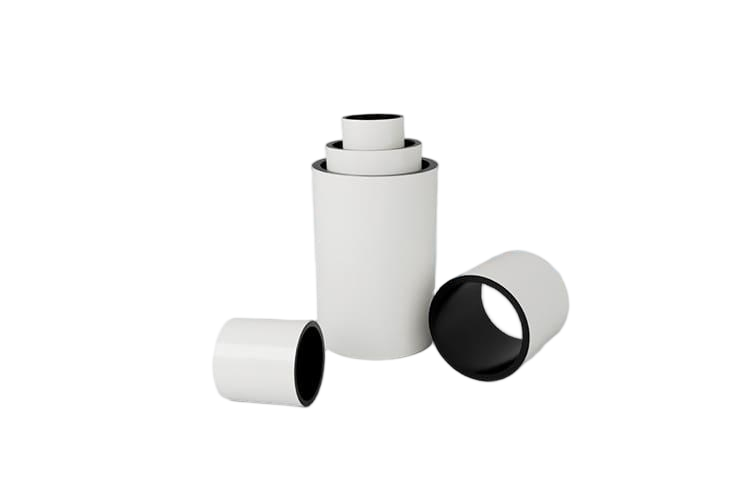
Co-extruded white-outer / black-inner HDPE is the Primepoly product of choice for above-ground mine lines. The white outer reflects up to 40% more heat than solid black, keeping the pipe wall 8–15 °C cooler in tropical sites — that translates to a 5–10% longer pressure life. The black inner is carbon-black for full UV blocking from inside, which matters when the line is partially empty between shifts. Joints are butt-fused on-site with W-series automatic machines; flange transitions to pumps and valves use stub-end + carbon-steel backing rings.
Irrigation: from center-pivot to drip
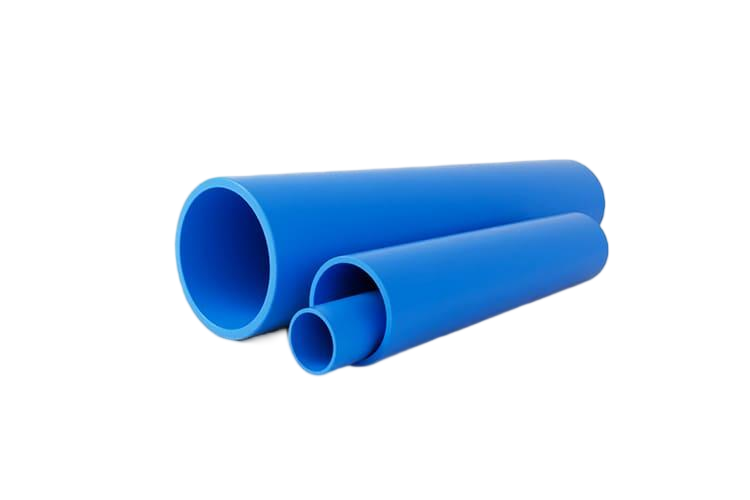
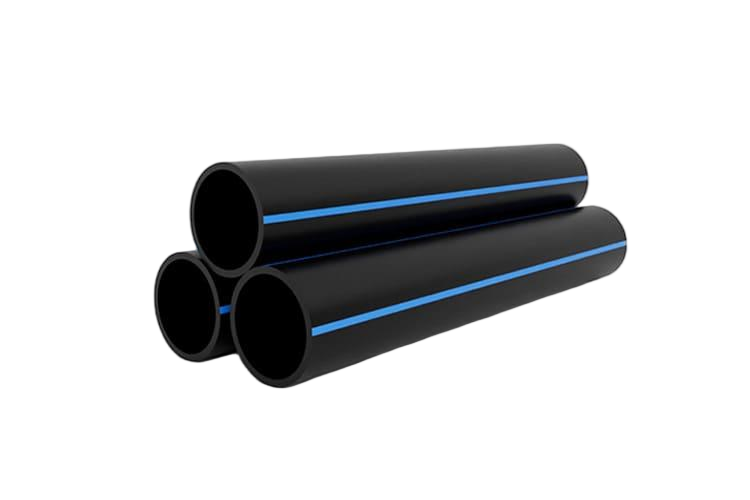
Irrigation pipelines look forgiving — low pressure, water-only, no abrasion. But the sun, the soil-temperature swing, and the pumping cycles tell a different story. A center-pivot field in Saudi Arabia runs surface-laid HDPE laterals at 30–45 °C ambient with twice-daily pump cycles. UV degradation is the killer: black HDPE with carbon-black UV stabiliser is the only formulation that survives 20+ years in that climate. Blue-stripe identification helps farm crew distinguish irrigation lines from buried utilities.
Drip-irrigation lateral lines are typically DN16-32 mm in SDR9 (PN16) — the small bore + thicker wall combo handles the sharp pressure-drop across emitters. Long-length coils (200 m+) let one truckload supply a 100-hectare field, and the flexibility of HDPE means the laterals can follow centre-pivot arc or contour without elbow fittings every 6 m. Submains are typically DN90 – DN200 in SDR17 / PN10. Dripper-line manufacturing tolerance is the QC priority — bore variation greater than ±0.05 mm causes uneven emitter flow and uneven irrigation.
Aquaculture: deep-sea fish cages
Modern marine fish farming uses HDPE floating cages anchored in 15–60 m of open ocean. The cage's two upper and two lower rings are large-diameter HDPE pipes (DN250 – DN355 mm SDR17–26) that double as buoyancy elements and structural framing. Salt water, UV, surface waves and storm loads all attack the polymer simultaneously. PE100 with marine-grade UV stabilisers + impact modifiers is the formulation; black is the dominant colour for maximum UV protection.
What distinguishes aquaculture pipe from any other application is the bracket / handrail system. Each cage has 24–48 cross-braces that connect the rings; these are smaller-diameter pipes (DN110 – DN160) with custom moulded fittings. Joints must accept fatigue loading from wave action — typical specifications require 10⁵-cycle fatigue testing of the joint design. Primepoly aquaculture-grade PE100 is one of the few products that passes this test for cages deployed in storm-exposed sites like Norway, Chile and southern Australia.
How the three applications compare
| Property | Mining slurry | Irrigation | Aquaculture |
|---|---|---|---|
| Resin | PE100 / PE100RC | PE100 / PE4710 | PE100 + marine UV |
| Typical DN | DN160 – DN800 | DN16 – DN200 | DN110 – DN355 |
| Typical SDR | SDR 11 – 17 | SDR 9 – 21 | SDR 17 – 26 |
| Colour | Black or co-extruded white-black | Black w/ blue stripe | Black |
| Joining | Butt fusion + flanged transitions | Butt fusion or compression | Butt fusion + custom fittings |
| Service life target | 10 – 25 years | 20 – 30 years | 15 – 25 years |
Specification checklist common to all three
- Specify the resin grade explicitly. PE100 is the baseline; specify PE100RC for slow-crack-growth-prone environments (mining, rocky burial), and confirm UV stabiliser concentration for above-ground use.
- Specify the colour / stripe scheme to match local conventions. Blue or blue-stripe for water; yellow / orange for gas; black for UV exposure; co-extruded white outer for hot tropical sites.
- Specify the SDR / PN class with safety margin. See our SDR/PN selection guide for the calculation; mining and pumped irrigation typically need one PN class above the steady-state demand.
- Specify the joining method up front in the WPS. Butt fusion for new trunk; electrofusion for tie-ins; flanges only at equipment transitions. Demand ISO 12176 operator certification.
- Specify the QA/QC documentation. For mining and gas projects we recommend 100% data-logged joints + 3.1 mill certs on every batch + a witness-test programme on at least 5% of joints.
The takeaway
Mining, irrigation and aquaculture each push HDPE in a different direction — but the underlying material physics are the same. The right resin grade, the right wall thickness, the right colour / UV protection, and certified fusion joints are the four levers that determine whether your pipe lasts 5 years or 50. Primepoly's engineering team has built this playbook from twenty years of project work; we'd rather quote your project once correctly than win it cheap and underperform. Send your application brief and we'll come back with a sized specification + reference projects from comparable sites.
Frequently asked questions
Need expert advice on your project?
Our engineering team helps utilities, contractors and EPCs specify the right pipe material and SDR for their project. Get a no-obligation technical consultation.
Talk to an engineer