Guide
How to Select the Right HDPE Pipe SDR / PN for Your Application
An engineer's guide to specifying HDPE pipe pressure class — from working pressure and surge to safety factors and the SDR–PN conversion that makes everything click.

Primepoly Engineering Team
Primepoly Engineering Team
Published: Apr 8, 2026
9 min read
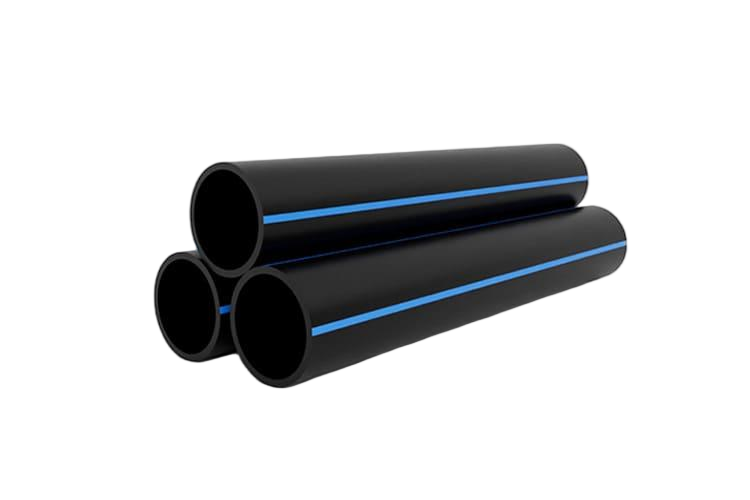
When buyers specify HDPE pipe, the diameter (DN) is usually obvious — but the pressure class is not. PN10 or PN16? SDR17 or SDR11? Get it wrong and you either over-pay for a wall thickness you don't need, or under-spec for a surge that will rupture the line three years in. This guide walks through the SDR / PN system, the working-pressure formula, and the practical rules of thumb our engineering team uses on every project.
What is SDR?
SDR stands for Standard Dimension Ratio. It is simply the ratio of pipe outside diameter (OD) to wall thickness (e). For a DN200 pipe with 18.2 mm wall thickness, SDR = 200 / 18.2 ≈ 11. The lower the SDR, the thicker the wall — and the higher the pressure rating. SDR is the parameter manufacturers extrude to, because the OD is fixed by the fitting standard but the wall thickness is what you tune.
Common HDPE SDR values are 41, 33, 26, 21, 17, 13.6, 11, 9 and 7.4 — corresponding to progressively thicker walls and higher PN. SDR is dimensionless, so it applies equally to a DN20 garden hose and a DN1200 mining slurry main. That universality is the reason ISO 4427, EN 12201 and ASTM F714 all standardise around SDR rather than absolute wall thickness.
What is PN?
PN is Nominal Pressure — the maximum continuous internal water pressure the pipe is rated for, at 20 °C, over a 50-year service life, with a safety factor of 1.25 built in. PN is expressed in bar (1 bar ≈ 14.5 psi ≈ 0.1 MPa). PN10 means 10 bar continuous service. The conversion between SDR and PN follows the basic hoop-stress formula: PN = (2 × MRS × C) / (SDR − 1), where MRS is the Minimum Required Strength of the resin (10 MPa for PE100, 8 MPa for PE80) and C is the design coefficient (1.25 for water).
| SDR | Wall ratio | PN (PE100) | PN (PE80) |
|---|---|---|---|
| SDR 7.4 | Wall = OD / 7.4 | PN 25 bar | PN 20 bar |
| SDR 9 | Wall = OD / 9 | PN 20 bar | PN 16 bar |
| SDR 11 | Wall = OD / 11 | PN 16 bar | PN 12.5 bar |
| SDR 13.6 | Wall = OD / 13.6 | PN 12.5 bar | PN 10 bar |
| SDR 17 | Wall = OD / 17 | PN 10 bar | PN 8 bar |
| SDR 21 | Wall = OD / 21 | PN 8 bar | PN 6 bar |
| SDR 26 | Wall = OD / 26 | PN 6 bar | PN 5 bar |
| SDR 33 | Wall = OD / 33 | PN 5 bar | PN 4 bar |
| SDR 41 | Wall = OD / 41 | PN 4 bar | PN 3.2 bar |
The 5-step SDR/PN selection process
Here is the workflow our application engineers use on every B2B project. Skipping any step — especially Step 4 — is the single most common cause of premature pipe failure.
- Determine the maximum operating pressure (MOP). For a gravity-fed water main, MOP = static head from the highest reservoir to the lowest delivery point. For a pumped system, MOP = pump shut-off head. Express in bar.
- Add a surge / water-hammer allowance. Sudden valve closure, pump start/stop, and check-valve slam can spike pressure by 2–10 bar above MOP. Use the Joukowsky formula or a transient analysis if the system is large.
- Apply the design factor. Add 25% safety margin (the C=1.25 already in the PN definition handles the resin side, but a separate operational margin protects against future de-rating).
- Pick the next-higher PN. If your calculated demand is 11.8 bar, do NOT pick PN10 — round up to PN12.5 or PN16. Plastic pipes do not tolerate over-pressure the way steel does.
- Adjust for temperature. PN ratings are for 20 °C water. At 30 °C derate by ~10%, at 40 °C by ~25%. Above 40 °C HDPE is generally not recommended for pressure service.
Quick decision flowchart
Recommended SDR / PN by application
| Application | Typical SDR | Typical PN | Why |
|---|---|---|---|
| Municipal water main (city pressure) | SDR 17 | PN 10 | Standard 10 bar service, ample margin for surge |
| High-rise / pumped water main | SDR 11 | PN 16 | Pump head + surge can hit 13–14 bar |
| Mining slurry / tailings | SDR 11 or 9 | PN 16 – 20 | Solids loading + transient cycles need extra wall |
| Gas distribution | SDR 11 or 17.6 | PN 10 (gas) | ISO 4437 mandates SDR 11 for high-pressure gas |
| Irrigation main | SDR 17 or 21 | PN 6 – 10 | Lower head, controlled valving, cost-sensitive |
| Drainage / gravity sewer | SDR 26 – 41 | PN 4 – 6 | No internal pressure; SDR matches stiffness need |
| Fire protection main (AWWA C906) | SDR 11 | PN 16 (DR 11) | Fire codes require pressure class margin |
The surge problem nobody talks about
Steady-state pressure is easy to model. Transient pressure — the spike when a downstream valve closes in 0.5 seconds, or a pump trips on a power outage — is the silent killer of plastic pipelines. The Joukowsky equation gives the maximum pressure rise: ΔP = ρ × a × ΔV, where ρ is fluid density, a is the wave celerity (about 350 m/s in HDPE because the pipe is more compliant than steel), and ΔV is the change in flow velocity. A 2 m/s flow stopped abruptly produces ~7 bar surge — enough to push a PN10 pipe outside its rating.
Five common SDR / PN selection mistakes
- Specifying SDR by habit. "We always use SDR17" is not engineering — every project has a different MOP profile. Always recalculate.
- Forgetting the static head from elevation. A reservoir 80 m above your delivery point adds 8 bar before the pump even starts. PN10 is unsafe in that scenario.
- Treating manufacturer test pressure as PN. Factory hydrotest is typically 1.5× PN. Working pressure is PN, not the test value.
- Mixing SDR classes on one line. A PN16 fitting connecting two PN10 pipes does not raise the rating of the system to PN16 — it stays at PN10. The weakest link defines the line.
- Ignoring temperature derating in hot climates. A SDR17 line buried 80 cm deep in the Saudi sun can hit 40 °C — that's a 25% derate from its 20 °C rating.
The verdict
SDR / PN selection is not a vibe — it is a calculation. Get the maximum operating pressure right, add the surge component, apply the temperature derate, and round up to the next standard PN. When in doubt, go one class higher: the cost premium between PN10 and PN16 in DN200 PE100 is roughly 30%, while the cost of replacing a ruptured main is the order of 100×. Our engineering team will run the calculation for you on any project — send your route survey + pump curve + valve schedule and we'll come back with a sized specification within two business days.
Frequently asked questions
Need expert advice on your project?
Our engineering team helps utilities, contractors and EPCs specify the right pipe material and SDR for their project. Get a no-obligation technical consultation.
Talk to an engineer