Guide
Butt Fusion vs Electrofusion: Choosing the Right HDPE Joining Method
Both joining methods produce welds stronger than the parent pipe. The right choice comes down to diameter, jobsite conditions, training and traceability.

Primepoly Engineering Team
Primepoly Engineering Team
Published: Mar 22, 2026
10 min read
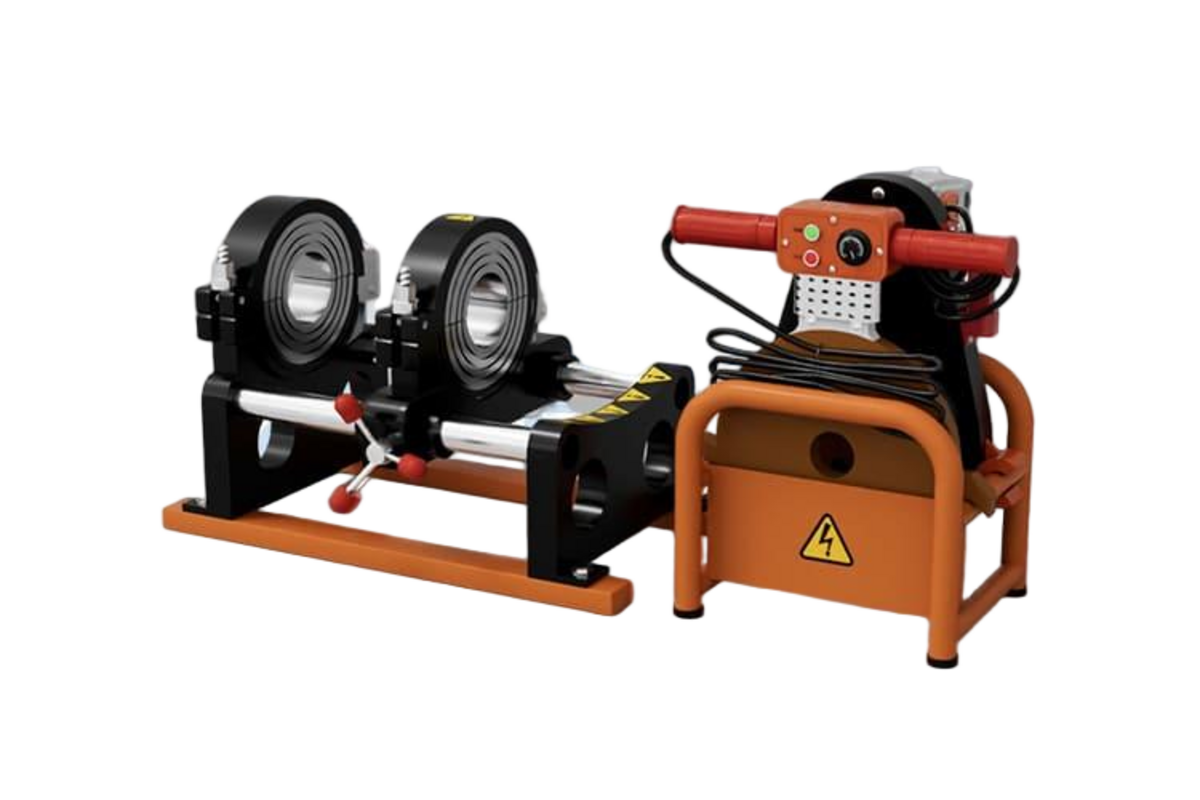
Butt fusion and electrofusion are the two thermal joining methods that have made HDPE pipelines the global standard for water and gas. Both produce homogeneous, monolithic joints with strength equal to or greater than the parent pipe — the property that lets HDPE go decades without leaks. But they differ in cost, speed, training requirements, jobsite practicality and quality-control traceability. This guide compares them head-to-head so you can pick the right method (or combination) for your project.
Butt fusion welding
In butt fusion, the two pipe ends are clamped square in a hydraulic machine, faced flat with a rotating planer, then heated against a Teflon-coated heating plate at 200–230 °C until a small bead of molten polymer forms. The heater is removed and the two ends are forced together at a controlled pressure for a fixed cooling time. The result is a continuous wall of molten and recrystallised PE — no inclusions, no gaskets, no failure plane.
Butt fusion is the workhorse for new pipelines DN90 mm and larger. Welding times scale with wall thickness — a DN200 SDR11 joint takes around 8 minutes, a DN800 joint around 45 minutes. Modern automatic / CNC butt-fusion machines (Primepoly W-series, McElroy TracStar, Hürner WhiteLine) data-log every parameter for traceability. Manual SPA-series machines remain popular for smaller diameters where the cost of an automatic unit cannot be amortised.
Electrofusion welding
In electrofusion, a coupler or saddle fitting with embedded resistance wire is placed over the pipe end, and the wire is energised at low voltage (typically 8–48 V) to melt the polymer at the pipe-fitting interface. Electrofusion control units like the DRB500E read a barcode on the fitting that tells the machine the correct voltage, time and energy compensation for ambient temperature. The operator scrapes the pipe surface, clamps the joint, scans the barcode and presses Start.
Electrofusion is dominant in three scenarios: (1) trenchless / space-restricted environments where a butt-fusion machine cannot fit; (2) gas distribution where regulators favour the data-logged, repeatable nature of electrofusion couplings; (3) repair joints, service tap-ins, and small-diameter branch saddles. The fittings cost more than butt-fused couplings (~10–25%) but installation is faster on small bore and forgiving in adverse weather.
Side-by-side comparison
| Property | Butt fusion | Electrofusion | Notes |
|---|---|---|---|
| Diameter range | DN90 – DN1200+ | DN20 – DN630 | Butt for big bore; EF for small + tap-ins |
| Speed (DN200 joint) | ~8 min | ~5 min | EF faster on small DN; butt faster on large DN |
| Equipment cost | $$$ (machine + clamps) | $$ (control unit only) | Butt machine is the big upfront cost |
| Fitting cost | $ (plain coupler) | $$ (resistance-wire coupler) | EF fittings cost ~10–25% more |
| Joint integrity | Stronger than parent pipe | Stronger than parent pipe | Both deliver monolithic joints |
| Traceability | Data-log on automatic machines | Built-in via barcode + record | EF easier to audit |
| Operator training | ISO 12176-3 (butt) | ISO 12176-4 (EF) | Both need certified welders |
| Best for | New trunk main, large DN | Tap-ins, repairs, gas, trenchless | Most projects use both |
Quick decision flowchart
Quality control & traceability
Both methods can produce 100% reliable joints — and both can produce catastrophic failures if procedure is violated. The two single biggest causes of plastic-pipe field failure are: (1) skipping the pipe-end facing or scraping step, leading to surface contamination; (2) insufficient operator training. ISO 12176 part 1 (butt fusion) and part 2 (electrofusion) certify the equipment; ISO 12176 part 3 / 4 certify the operator. Reputable contractors will not let an uncertified welder near a project pipeline.
Five common fusion-welding mistakes
- Skipping the pipe-end scraping step on electrofusion. Even invisible surface oxidation prevents proper fusion. Always scrape to fresh PE within 5 minutes of welding.
- Misalignment in butt fusion. Pipe ends must be parallel within ±1 mm at the butt face. Out-of-square ends concentrate stress and pre-load the joint with bending moment.
- Skipping the cooling time. The joint is only at full strength after the documented cooling time elapses — typically 1.5× the heating time. Removing clamps early under-strengthens the joint.
- Welding in cold weather without an enclosure. Below ~5 °C, butt-fusion bead formation slows and electrofusion energy compensation gets unreliable. Use a tent and pre-heat the area.
- Mixing welding standards on one project. ISO 21307 has different parameters from ASTM F2620 — use one standard per project and document it in the welding procedure specification (WPS).
The verdict
For new pipelines DN90 mm and larger, butt fusion is the most economical and fastest method. For tap-ins, repairs, small-diameter service connections, gas distribution, and any space-restricted job, electrofusion is the right answer. Most real projects use both: butt fusion for the trunk main, electrofusion for service connections and tie-ins. Specify both methods in your tender and let the contractor optimise — but require ISO 12176 operator certification + data-logged joints regardless of method.
Frequently asked questions
Need expert advice on your project?
Our engineering team helps utilities, contractors and EPCs specify the right pipe material and SDR for their project. Get a no-obligation technical consultation.
Talk to an engineer